
 News & Updates
Haley Van Cleve on Growth Investor Podcast
On GrowthCap’s Growth Investor podcast, Partner Haley Van Cleve discusses how Alpine’s PeopleFirst approach finds CEOs, develops young investors, and...



This article was originally published on Graham Weaver’s blog.
By Graham Weaver, Founder and CEO, Alpine Investors
In 2009, the Alpine team came to the realization that our core business is not investing — we are actually in the talent business. Upon realizing this, we began focusing our resources on continuously improving our hiring function. This move proved to be a major catalyst for Alpine’s growth. In the ensuing years, we increased our assets under management by 4,400% from $240 million+1 to $11 billion+2 and grew the Alpine ecosystem from 20+ team members to 215+ professionals across the country.3
Through research, focusing on our bright spots, and (sometimes painful) trial and error, we learned to eschew many conventional hiring beliefs and practices in favor of blazing our own path. Here are the three most surprising and impactful practices we learned:
If you’ve never heard the terms “episodic hiring” or “programmatic hiring,” fear not. I made them up.
Think of episodic hiring as the targeted approach to engaging a single candidate: Hire a recruiting firm, build a scorecard, screen candidates, bring the finalists in for an in-person day, conduct deep-dive interviews, score, sell, hire, and onboard the candidate. Although this process is expensive, time-consuming, and competitive, it may be the best one for one-off hires and senior leaders such as a CFO, Chief Product Officer, or VP of Sales.
However, we also have roles we need to fill consistently. These are often people closely associated with the product our company provides: technicians at an HVAC firm, engineers at a software company, accountants at an accounting firm, or analysts at a private equity firm.
To transform these hiring processes, we make them programmatic versus episodic. Programmatic hiring typically has the following characteristics: (i) you hire an entire “class” of people at once, (ii) you align this hiring with a big pool of available candidates — such as people graduating from high school, college, or business school, (iii) there is often a heavy onboarding and training component, and (iv) it takes longer for these hires to be productive than their more experienced counterparts (see point #2, “Hire for attributes over experience,” below).
The onerous onboarding and long ramp times dissuade most leaders from investing in programmatic hiring. And make no mistake, it is an investment. As I write this (in May 2023), Alpine is hosting coffee chats with college sophomores for our June 2024 summer intern class, many of whom will become full-time analysts in August 2025, and will be fully productive (after an entire year of training) in August 2026. We are spending considerable time and resources recruiting people who will not be fully productive for us for more than three years. On top of the time frame itself, we invest significant resources in training, mentoring, and onboarding throughout that time.
As the Chinese proverb says, “The best time to plant a tree is 20 years ago. The second-best time is now.” If you can plant these trees today, the returns are well worth the effort because you can: (i) build an in-demand brand at schools and attract exceptional people year after year, (ii) achieve efficiencies and camaraderie by onboarding several people at once, and (iii) create a loyal, high-attribute group of people who don’t need to unlearn bad habits. Investments in programmatic hiring have provided a massive competitive advantage to Alpine and our portfolio companies.
If you hire a recruiting firm to find a CFO for a healthcare software company, they will likely focus on finding existing CFOs of other healthcare software companies. Then they will filter candidates who want to live in your geography, are interested in leaving their jobs, are attracted to your company, and have whatever other criteria you demand (Big 4 accounting experience, an MBA, etc.). By searching in this way, you significantly reduce your pool of candidates — not to mention that you make the chances of increasing diversity at the senior levels of your company extremely slim. Further, by overweighting the specific healthcare software experience, you may have underweighted much more important criteria.
Many of the best CFOs we’ve hired within the Alpine portfolio have never previously been a CFO. For example, in 2019, we brought on Will Matson as the CFO of a to-be-formed services platform. Will came from an investment banking background and had no experience being CFO (or controller or VP finance for that matter). Initially, Will had to climb a steep learning curve, building his expertise in finance, accounting, IT systems, and ultimately mergers and acquisitions. What Will lacked in experience, he made up for in attributes. He possessed a will to win, grit, intellectual horsepower, and ultimately the ability to build a team and inspire followership. In a short time, Will became one of the best CFOs in the world, playing a large part in helping to grow the revenue of that company from $40 million to $1.7 billion in less than four years and ultimately assuming the role of President.4
Will’s path followed a common trajectory of high attribute/low experience candidates as represented by the curve below.
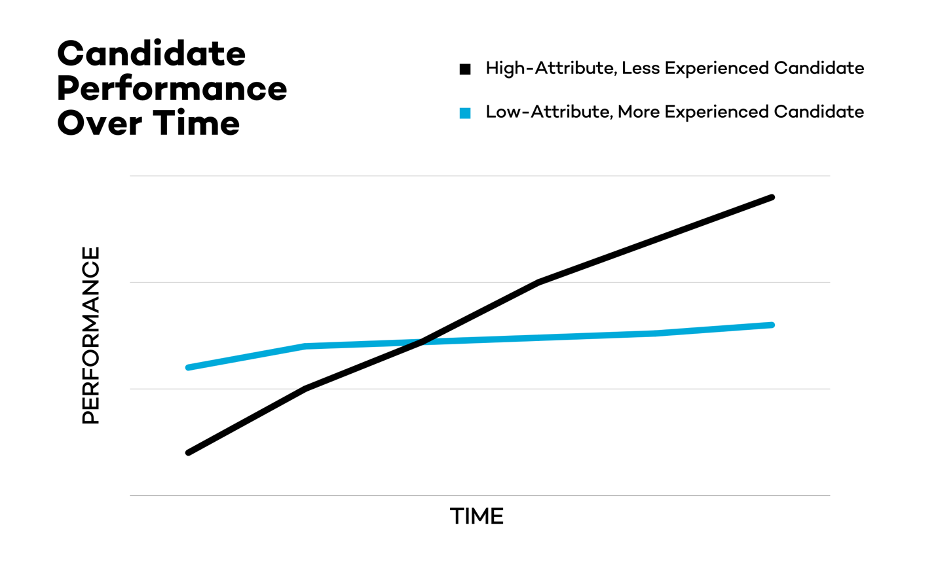
To be clear, this strategy is not a knock on direct job-related experience, but an underlining of how the right attributes lay the foundation for outsized performance as that person gains experience, both in the near term and over the course of their career.
This mantra sounds so simple and yet so many companies have a difficult time following it. Why? Because exceptional people demand a unique culture and many of the things required to create this unique culture are very hard to implement and/or counterintuitive.
Here are a few of the most common mistakes leaders make in their culture. These mistakes may deter the very best people:
Making your company a great place to work is not only crucial for attracting the best people, it is also essential for retaining them.
Have you ever thought about the true cost of churn? If we lose an associate who has been with Alpine for three to four years, we not only lose their current capability of analyzing deals, helping companies, and training analysts, but we also lose the next decade of their potential to lead investments, create industry theses, chair boards, and lead Alpine.
The cost of employee churn is 15x the employee’s salary, according to assessment firm GH Smart. I believe that number is understated. If you think about the lifetime value of an A+, happy professional, where would making your firm the place where they want to work fall on your priority list?
You may have noticed two common threads among these three lessons: (i) they require long-term focus, and (ii) they are far more challenging than maintaining the status quo. An obsession with short-term results has created a pervasive culture of undermining human connection at work. Focusing on that connection — making sure people are happy at work, that they possess the right intangible attributes, and that you can consistently attract those people at scale — is THE silver bullet to creating a world-class company. It isn’t easy, but there is no greater return on your time as a leader.
If you’re considering a sale, our team can walk you through what to expect and how to get started. Book a 15-minute call to learn more about what a transition could look like for you and your business.
Book a call with our team today to get started News & UpdatesOn GrowthCap’s Growth Investor podcast, Partner Haley Van Cleve discusses how Alpine’s PeopleFirst approach finds CEOs, develops young investors, and...
 News & Updates
PitchBook's Jessica Hamlin spoke with Alpine Partner Matt Moore about how our CIT program identifies future CEOs, often before a company exists…
 Stories
Eight Group is a U.K.-based facilities management business built to scale through acquisition and operational excellence. Alpine Operation Group’s Talent...
No strings attached. Unsubscribe anytime. For further details, review our Privacy Policy and Terms of Service.