 News & Updates
Pitchbook: How Alpine and Shore Capital build CEOs instead of hiring them
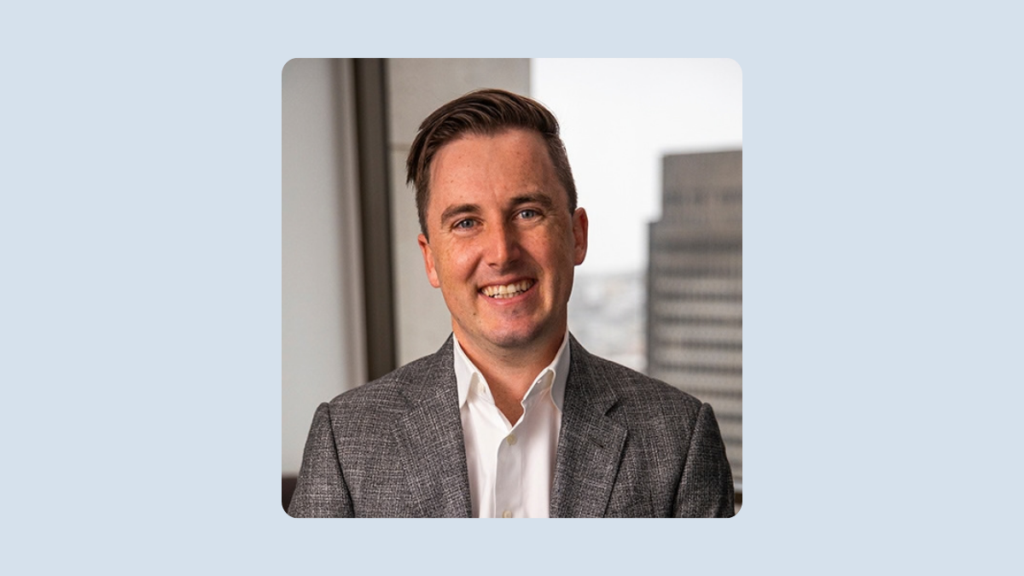
PitchBook's Jessica Hamlin spoke with Alpine Partner Matt Moore about how our CIT program identifies future CEOs, often before a company exists…




When I graduated from college, I was full of energy and ready to run through walls.
Excited to land a job at a well-known investment bank, I quickly realized Wall Street was nothing like the movies. Instead of exciting, high-stakes action, I learned to navigate Lotus—later Excel—without a mouse and page-check investment memos. Most days, I would wait around all day, and then around 8 p.m., my boss would drop a pile of work on my desk and demand it be completed by the morning. As someone who prides myself on time management, I found it deeply deflating.
What was particularly scary was how quickly I began changing myself—trying to succeed in a culture that valued hours in the office. I stopped asking for any time off. My mom saved up money to come visit me from Ohio one weekend, and I saw her for only a few hours. I missed my friends’ weddings and even my own grandmother’s funeral. It pains me to write that even 30 years later, but it’s true.
I had entered that job thinking I was a certain kind of person, with a certain set of values. But, within months, my environment had started to reshape me. I thought I was stressed because of the long hours and high demands, but I think the real root of that stress was primarily that I did not admire the person I was becoming.
Three years later, my cubemate and future roommate, Derek Coppoletti, and I packed up my station wagon and drove from New York to Palo Alto to attend Stanford Business School. Somewhere over those 3,000 miles, and during the months that followed, I realized the first lesson that would shape Alpine: Your environment is more powerful than you think; you become the people around you.
Thankfully, I would later learn that this truth works just as powerfully in the positive direction. Surrounding myself with people who shared my values—and who made me want to become a better version of myself—would become one of the cornerstones of Alpine’s success and my own growth over the next 25 years.
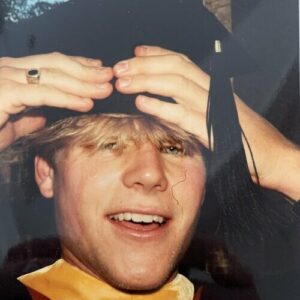
Graham Weaver, 1994
During my two years at Stanford, in between classes, I bought three companies as a fundless sponsor, a term that didn’t exist at the time but basically refers to someone buying businesses without a fund. Those deals were incredibly difficult to pull off, and my reward was a hodgepodge of companies that didn’t perform well initially, to put it mildly.
After one more stint with an institutional private equity firm after graduation, with my impressive track record of one deal that was sort of performing and two that were struggling mightily, I set out to start Alpine Investors at the age of 28.
I started Alpine because I wanted to create the firm where I wanted to work: a firm where the person who wants to run through walls is celebrated—and actually given somewhere worthwhile to run.
Raising the first fund took more than a year, as I was an easy “No” for most potential investors. Eventually, two individual investors saw something in me that I had not yet fully seen in myself. They were willing to back a young, unproven person with more energy than experience. Without their belief, Alpine would not exist.
With their investments, “we” (the Alpine team had doubled to two with the addition of a summer intern, my cousin Danny Sanner, who was in college and still sported a puka shell necklace) raised a $54 million first fund in August 2001. And Alpine was born.
As a private equity firm, Alpine buys and helps build companies. At least, that is the simple description. What Alpine would eventually become is a group of people assembled around a deeper belief: that exceptional people, given real ownership and the right environment, can grow faster and accomplish more than anyone—including themselves—could have predicted. But that belief was not a strategy we wrote down in 2001. We would have to learn it the hard way.
At first, we bought companies we thought had great potential and strong existing leadership. The prevailing “rule” in private equity at the time was the same rule my idol, Warren Buffett, preached: back existing leadership teams and wait for the returns to follow.
To our horror, they didn’t.
In several cases, we misjudged either the leaders, the companies, or both. Some leaders turned out to be less capable than we had hoped. Others lost motivation after the transactions closed and the checks cleared. Mostly, we learned that the model we were copying did not fit the truth of who we were or what really gave us energy.
We had to make Fund I work, but we were in a bad way for the first several years. With no obvious alternatives, our team did something unconventional; we went in to run the struggling businesses ourselves.
By this time, we had grown to eight team members, and each of us was willing to do what we needed to do to make Alpine work. Will Adams moved to Maine for two years to run a call center. Danny Sanner (no longer an intern or puka shell enthusiast) moved to Detroit to run a label-printing company. My brother Ned moved to New York to run our vending machine business. Mike Duran spent most of his time in Chicago turning around an electronics distributor, and he later became CEO of our online education business. Later on, I became CEO of our struggling slot machine business, and we also recruited people from our networks—Josh Greenberg, John Fowler, and Mark Strauch (who would later become a partner at Alpine) to run several other portfolio companies.
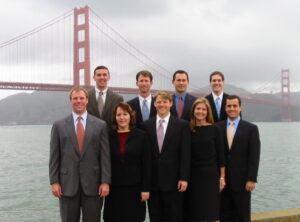
Alpine’s Founding Team, 2003
It is easy to look back on this time with nostalgia, but none of it was glamorous. Danny painted the walls of the manufacturing plant at 4:30 a.m. so the team would have a better place to work. Will shoveled snow off the roof during Maine winters to keep the facility from caving in. We did whatever it took.
When we called our own number to run these companies, a funny thing happened. Because the newly minted Alpine CEOs knew little about the industries they entered, they also weren’t encumbered by the “rules” of those industries. It didn’t take long before our portfolio companies with the mid-20s and early-30s Alpine-placed CEOs became the most successful businesses in our portfolio.
We did not set out to create a new private equity model, and at first, we didn’t even realize we had.
One day, Matt Picciano, Mark Strauch, and I attended back-to-back board meetings. The first was a highly frustrating meeting with a company where the founder we backed spent the entire meeting making excuses and politely nodding as we made suggestions. Everyone in the room knew nothing was going to change.
The second meeting was with Mike Duran, who was running our online education business. We literally and figuratively sat on the same side of the table with Mike, and he was three steps ahead of us the whole time. Our only job was to clear the building’s debris as best we could as he ran through and broke down the walls.
After the meeting, at a nearby bar, Matt made an offhanded comment after a few beers, “What if we just put our own teams in every time?” We both laughed. Wouldn’t that be nice?
And then several months later, we found the courage to do just that.
We stopped seeing the people involved as one part of the investment process and started seeing them as the center of the whole thing. We had been trying to win deals when we should have been trying to back extraordinary individuals. I remember writing in my notebook, in letters that filled the page:
That sentence became one of the major turning points in Alpine’s history. It applied not just to the portfolio but to Alpine itself. The lesson was not that Alpine had discovered the only investment model that would produce great returns. Many firms, including Berkshire Hathaway, have built extraordinary businesses in very different ways. The deeper lesson was more personal than that: You cannot build something extraordinary by copying someone else’s formula. You have to listen carefully for what gives you energy and then have the courage to move toward it.
Fund I took 11 years to wind down, and the returns fell well short of expectations. But hidden inside that difficult first fund was the model that would define Alpine for the next two decades.
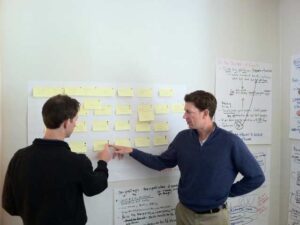
Will Adams, Billy Maguy, 2011
Once our new model became clear, my job began to change. I spent less time searching for the next great deal and more time trying to help build the kind of firm where exceptional people would want to spend their careers. If talent was going to be the center of Alpine, we had to do more than admire great people when we happened to come across them. We had to build a system that could find them, support them, challenge them, and give them real ownership earlier than most places would. We also wanted Alpine to be a place where people could spend their entire careers—careers that might span from summer intern to Alpine partner.
We started recruiting college students directly out of school, ultimately creating an annual summer internship for rising college seniors. One of our early undergrad recruits was Haley Van Cleve, a computer science major who knew little about finance, let alone private equity. Her learning curve was steeper than it would have been if she had gone to an undergraduate business school and spent several summers interning on Wall Street. Instead, Haley brought a fresh look at nearly everything.
Haley leaned into her passion for software. Along with Mark Strauch, Billy Maguy, Jake Brodsky, and Steve Reardon, she helped build Alpine Software Group (ASG) around a different idea: rather than competing head-to-head with every major private equity firm to buy large software companies, we would aggregate niche software businesses and give them access to shared resources they could never build on their own. ASG has since acquired over 60 businesses and is one of Alpine’s largest companies.¹ Ten years after joining Alpine straight out of undergrad, Haley is now a partner and leads all of investing.
It is easy to say you put people first. The difficult part is doing it. The “magic” is helping people identify the work they are uniquely good at—and that gives them energy—and then making room for them to do it. That can be highly inconvenient in the short term, because it often means letting them leave a role they are currently serving in to start in the role that truly energizes them.
Jeff Totten began as a summer intern at Alpine in 2012. He soon joined full-time as an analyst and later became one of our highest-performing Vice Presidents. As we spent more time with Jeff, it became clear that his true passion was to become the CEO of a diversified holding company with permanent capital. We co-created a role for him, and he ultimately formed Evergreen Services Group, a holding company focused on acquiring and operating technology services companies. Although Jeff’s departure left a hole at Alpine, his new role fully unleashed him. Starting from a $3 million EBITDA company in early 2018, Evergreen has grown to over $1.66 billion of revenue and over $268 million of EBITDA, and it shows no signs of slowing down.²
Will Chance and Pat Eble first came to Alpine in what were essentially part-time investing jobs while they trained for the 2020 Olympic rowing team. Over time, each of them began pulling toward a different part of Alpine. Will loved helping companies after we bought them and went on to help build Atlas, our post-close value creation team, which he now leads. Pat loved building relationships with bankers and exploring new markets, and he now co-leads our thesis development efforts. They had the same starting point but completely different sources of energy.
Yes, our goal is to produce great returns for investors, but the path to that goal traverses through people operating at their highest level. And that path involves working with each person on our team and finding the bespoke path that most lights them up.
Over time, we built an entire system around this belief. We developed a rigorous approach to talent assessment, built our own sourcing organization to find companies where we could put in our own teams, formed Atlas to support leaders after closing, and translated Alpine’s own operating practices—such as continuous improvement, quarterly renewals, and one-page-plans—into systems our portfolio companies could use. Each of these tools took years of mistakes and iteration to build. But together, they helped us build our PeopleFirst aspiration into a repeatable model.
We also stood up a CEO-in-Training (CIT) program to embody this philosophy in our portfolio. The idea was as simple as it was ambitious: hire early-career, high-attribute MBAs with limited operating experience, teach them how to run companies, and put them on a quick path to become CEOs. The program got off to a slow start. The first year, I couldn’t get any of our CEOs to hire a CIT: “So, you’re telling me you want me to hire someone who is twice the cost, has zero experience, and wants to be promoted every 12 months?”
Yup. That was our pitch.
The following year, we agreed to reimburse one of our CEOs for the CIT’s salary if she (Laura Walsh) didn’t work out. Laura crushed it. She was not only the best employee the CEO had ever hired; she reset the bar for what great looked like at the company. The next year, the CEO returned, asking if we had “three more Lauras” he could hire. We were onto something.
We have since placed over 150 high-attribute leaders across our portfolio companies using this method.³ As the program was getting off the ground, though, we were just learning to see potential in people before they fully saw it in themselves and then giving them the chance to grow into it. For the first time, Alpine did not feel like a private equity firm trying to copy someone else’s model.
It felt like we had found the work we were meant to do.
Our model took time—and lots of mistakes—to work out. We had many hiring and investing misfires, and initially struggled with the model of transitioning young, new leadership into growing companies.
In the back of my mind, I often thought of my father, who had started his own veterinary practice around the time I was born. At the beginning, he had no clients, so he made emergency calls to pay our mortgage and slowly build his practice. Saving animals’ lives in the middle of the night won him lifelong clients and glowing referrals. Twenty years later, his 50th birthday present to himself was finally stopping those 2 a.m. calls. When he started, he thought building a business would go much faster. But he built a strong foundation, brick by brick, and the results followed. Watching him, I learned that great things take time.
The same was true for Alpine. A decade after starting the firm, we were reeling from the Great Recession and struggling to raise our fourth fund. Fifteen years in, we still had a hard time convincing the very best people to take a chance on Alpine. For a long time, our own internal belief was much stronger than the evidence we could present to the outside world.
I often think of a bit of wisdom my executive coach, JP Flaum, shared with me back then: “Great people will surprise you on the upside.”
Eventually, that’s exactly what happened.
With the benefit of time, the team at Alpine became formidable leaders. We bought better companies and attracted incredible people to run them. Many of our early CITs became platform CEOs and ultimately built (and continue to build) amazing companies. You can read more about them here.
In March 2026, the HEC Paris-Dow Jones Upper Mid-Market Buyout Performance Ranking evaluated over 695 private equity firms and recognized Alpine as the #1 performing upper mid-market firm based on a composite of return metrics across our funds.⁴ We are proud of that, of course. But what matters more is what the recognition confirmed: following our own internal compass and trusting our team led us to build something truly special.
The lessons in building Alpine are much clearer today than they were while we were living them. You become your environment over time—so choose your team carefully. People are the most important part of our model and are capable of far more than they realize—and our job is to help them unleash that potential. The work that gives you energy is usually the work you should be doing. There is typically a long lag between doing the right things and reaping the rewards of those actions. And building almost anything worth building takes time.
In many ways, Alpine has come full circle. We exist because two early investors believed in me, a young, unproven founder, before I had fully earned it. For the past 25 years, we have tried to pay that gift forward—creating the right conditions to unleash the heroes inside the people who join Alpine, the leaders who run our companies, the founders who trust us with what they built, and the employees across our portfolio who show up every day trying to build something wonderful.
As we celebrate 25 years of Alpine’s history, I can’t help but think about its future. What excites me most is the team we are building and the incredible roles that team will take on and grow into. Talent is the key leading indicator in any business. And from that metric, Alpine’s future is incredibly exciting.
I look around at my colleagues—from those just joining our team to those who have been with us since the early days—and feel a deep well of gratitude for not only their trust in what we’re building together, but their willingness to do the hard work each day of unleashing the heroes inside themselves.
That is the force we want to be in the world: a force that unleashes as many heroes as possible.
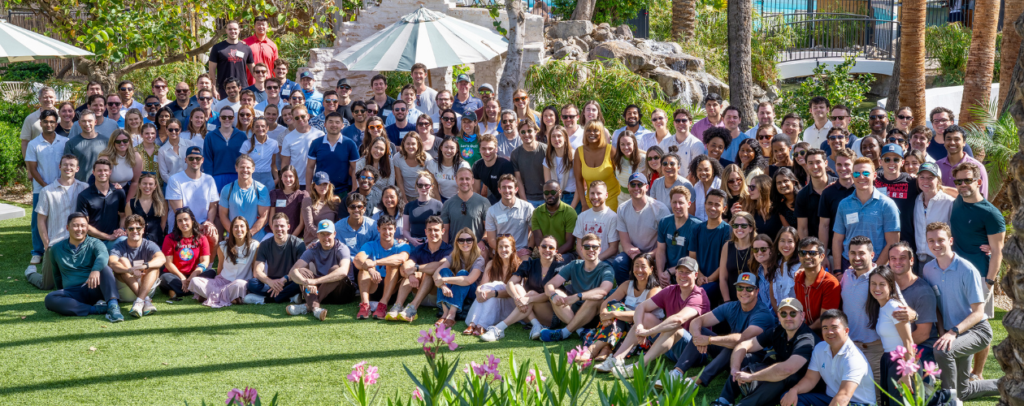
The Heroes of Alpine Investors, 2026
¹ As of August 1, 2026.
² As of March 31, 2026.
³ As of August 3, 2026. Compensation, expense reimbursements, and equity interests received by CITs, PeopleFirst Executives, and Alpine Operations Group professionals are generally borne by the applicable Alpine Fund(s) and/or portfolio companies without offset to the management fee.
⁴ The 2025 HEC Paris-Dow Jones Upper Mid-Market Buyout Performance Ranking, published March 6, 2026, was based on funds raised between 2012 and 2021. Alpine provided fund information upon request and did not provide compensation in connection with obtaining or using this ranking. Methodology: https://www.hec.edu/en/private-equity-ranking.
If you’re considering a sale, our team can walk you through what to expect and how to get started. Book a 15-minute call to learn more about what a transition could look like for you and your business.
Book a call with our team today to get started News & UpdatesPitchBook's Jessica Hamlin spoke with Alpine Partner Matt Moore about how our CIT program identifies future CEOs, often before a company exists…
 Stories
Eight Group is a U.K.-based facilities management business built to scale through acquisition and operational excellence. Alpine Operation Group’s Talent...
 News & Updates
Alpine Principal Jack Armstrong, spoke with PE Hub about the opportunity in the UK hard facilities management market and our plans for…
No strings attached. Unsubscribe anytime. For further details, review our Privacy Policy and Terms of Service.